

FIRST PRINCIPLES
The foundation of Power-Literate Authority™, and why it matters for you.
You already have power. This is how you see it clearly.
We've shown up and built something real in the relationships and systems we move through — community, family, organization, other rooms that matter. We've developed our skills, clarified our values, built connections, and delivered results. Consistently. Courageously. Sometimes even at personal cost.
And yet, most of us have been given very little to work with when it comes to understanding how power actually moves.
We're often told that confidence, communication, and strategic thinking are foundational elements to master, and that competence naturally translates into authority. That if you do the work well enough and long enough, the recognition will follow.
Research and lived experience tell a richer, more precise story.
Authority doesn't follow competence automatically. It moves through systems — and systems have their own rules.
Those rules are rarely written down. They live in patterns: who gets heard in which room, whose ideas move forward and whose get quietly set aside, who absorbs the risk when things are uncertain and who receives the credit when they resolve. They're established early. They shift without notice. And they shape what's possible in ways that have nothing to do with how capable you are.
You can have power that a system fails to recognize as authority. That gap — between what you bring and what the system allows to move — is exactly what PLA maps.
Naming those patterns — precisely, in the context of your specific system — is where clarity starts. That is what PLA is for.
Power-Literate Authority™ begins from a single assumption: you already have power — real, earned, present power. The work of PLA is not to find it or create it. It's to make it visible. To clarify where it stands in your specific system right now, where it's ready to move further, and what conditions are shaping both.
The output is a clear-eyed picture of where your power is already working, where it's ready to grow, and where your energy investment will return the most. It's built from what's actually happening in your system — the events, the relationships, the dynamics that shape what's possible for you every day — not from theory, and not from what anyone assumes should be true.
This is what makes Power-Literate Authority™ different from other frameworks for navigating power. It doesn't start with what's wrong, or what's missing, or what you should do differently. It starts with the authority you've already built — and works outward from there.
A practice, not a prescription
Power-Literate Authority™ is a diagnostic practice for understanding how authority actually moves in the systems you navigate — so you can invest your energy where it holds, and make decisions you trust.
It works in any system. A workplace. A family. A community. A faith context. A volunteer organization. Anywhere power moves through relationships, timing, and dynamics that rarely get named out loud. PLA doesn't require a formal title, a hierarchical structure, or an organizational chart. It requires only that you are navigating a system that matters to you — and that you want to understand it more clearly.
Two terms matter here, and PLA uses them precisely throughout.
Power
What you bring — the capacity, presence, and earned influence you carry into every system you navigate. Power belongs to you independent of any system's recognition of it.
Authority
What moves — the ability to act, decide, and influence within a specific system, shaped by the conditions and relationships that system contains. Authority exists in the interaction between your power and the system you're in.
The relationship between the two is what PLA maps.
It begins as a diagnostic — a structured, guided process for mapping how authority moves in your specific situation so you can move with intention and care. And it becomes a lifelong practice: a lens you return to every time you enter a new system, take on a new part in an existing one, or find that the conditions around you have shifted.
PLA does not tell you what to do. It helps you see what's true — so what you do holds.
This distinction matters. PLA does not prescribe action, recommend a path, or tell you whether to stay or go, push forward or pull back. Every one of those decisions belongs to you — PLA is designed to help you see with as much clarity as possible.
It’s a leadership and personal development tool specifically created for this purpose, and what it offers is precision. Before asking how do I build more authority here? — PLA asks questions that make that question answerable: Can authority move in this system? Under what conditions does it move? Where is your energy already compounding — and where is it going to waste?
These are questions that keep your effort from going somewhere it cannot hold.
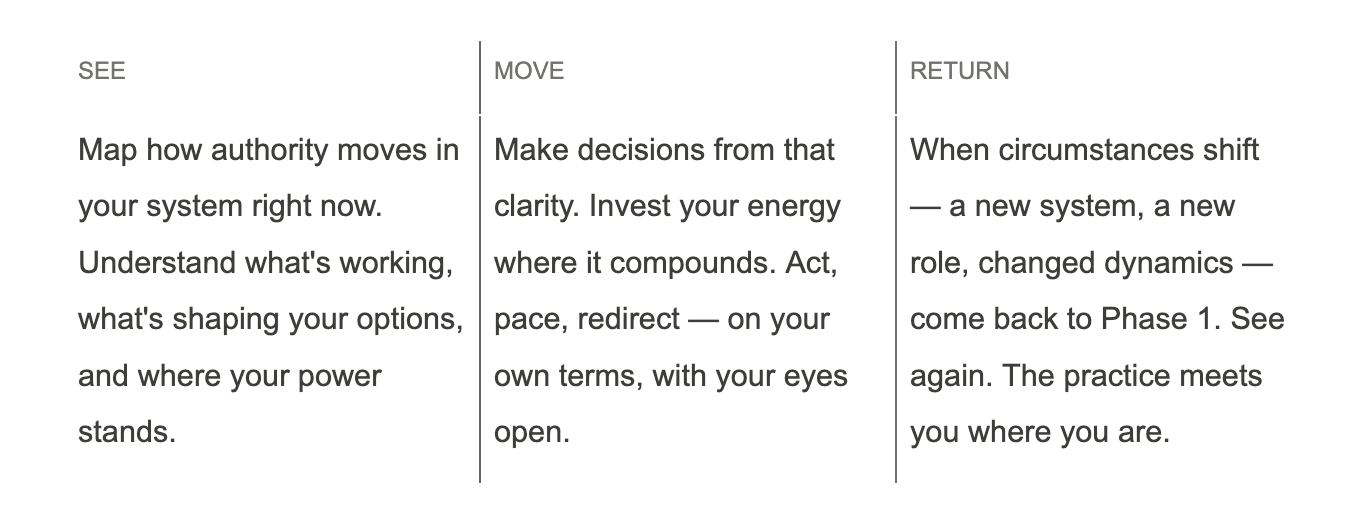
The Practice Model
The practice model is simple, and it stays with you.
Like any real practice, PLA grows with you. You don't complete it — you return to it, because you and your circumstances keep changing. A new room, a new relationship, a promotion, a pivot, a shift in who holds power around you — any of these is a signal to see again before you move.
For those whose system is ready to hold more, Phase 1 opens the door to Phase 2 — a deeper practice of intentional authority investment. Importantly, that door opens from clarity, not before it.
PLA is built on six principles
These are the principles Power-Literate Authority™ is built on. They are patterns observed, tested, and lived across three decades of experience at the intersection of women, power, and systems — and they are affirmed by research. They may feel like truths you already sense. Power-Literate Authority™ gives you the language and the tools to work with them directly.
Principle 1
Authority moves early — and keeps moving.
First impressions, early relationships, initial positioning — these set patterns that can be remarkably durable. And they can shift without warning, after one year or twenty.
Principle 2
Authority moves informally — often long before anything is decided officially.
Before a decision is announced, authority is already on the move.
Principle 3
Authority moves through people.
Sponsorship, timing, and trust are not soft variables.
Principle 4
Functions, not necessarily the human doing them, are often what's protected.
Often a system protects the function while the human performing it may or may not be protected.
Principle 5
These dynamics are not unique to any one person — yet they do not always land equally.
Anyone navigating complex systems encounters informal authority dynamics. Women's authority in particular often moves differently, and can become precarious once granted.
Principle 6
Authenticity is not separate from power. It is power.
Authority that requires you to suppress who you are in order to access it is not sustainable. PLA measures this directly.
These principles don't change your system. They change what you can see — and therefore how you choose to move within it.
PLA measures seven dimensions
PLA is a guided process that examines authority across seven dimensions. Together they produce a complete picture of how authority moves in your specific system — where it's working, where it's ready to grow, and what conditions are shaping both.
Each dimension includes a precise statement of what is being measured. The diagnostic begins by mapping where each dimension is already working before examining where it is constrained.
The Seven Dimensions are:
Role-based Clarity
Advocacy Strength
Access and Information Flow
Authority Protection under pressure
Risk Distribution Symmetry
Dissent Toleration Level
Authenticity Acceptance
Seven dimensions. One complete picture. Built from what's actually happening in your system.
What you get
The diagnostic produces a clear-eyed picture of how authority moves in your specific system — across all seven dimensions, grounded in what has actually happened based on your input. From that picture, PLA generates three orienting documents and one summary:
Mobility Score
Structural Map
90-day Posture Plan
Session Data Summary
These documents together make up your Authority-Mobility Map for Phase 1. They show what the conditions in your system currently make possible and what they suggest about how your energy is best invested right now. Every decision about what to do with that information remains yours.
What happens next
PLA is currently in the public PILOT phase and we’d love to have you participate!
Click below to receive the PLA PILOT diagnostic by email.
See clearly. Move with intention. Return when things shift.